Just a brief comment regarding how poor Virgin Media, amongst others, are at communication.
ISPReview hailed the arrival of Virgin Media to this local area on 14th April. Virgin Media had actually completed their digging by 6th April, with the bulk of it completed in March. The infrastructure has sat idle since then. The cabinets shown by ISPReview have no power, and all attempts to get some answers from Virgin Media as to what is holding things up and when potential customers will be able to order have not been responded to.
Cheers for giving me so much to work with when people ask when they can order, guys!
Tuesday, 24 May 2016

Monday, 4 April 2016
The scale of the task - Openreach urban FTTP
I felt that my caution over BT claims to be serious about deploying 'consumer' grade FTTP merited some explanation and, ideally, data, to illustrate the scale of the task in hand.
Here are stats from Thinkbroadband.com covering the 10 most populous cities in the country outside of London.
Here are stats from Thinkbroadband.com covering the 10 most populous cities in the country outside of London.
No single chart is available for Edinburgh and Bristol so the stats have been compiled from individual constituencies. The accuracy of the alternative network figure in the context of the Think Broadband figures can't be guaranteed, the accuracy of the Openreach one can. Spoiler: it's 0% for both authorities.
In summary, of the 10 most populous cities in the UK 6 have zero native FTTP from Openreach, 2 have 0.05% coverage or less, and of the final 2 one is at 0.46%, the other, London, 1.45%.
8 of the 10 have more FTTP from other operators than Openreach, the exceptions being Bradford and Edinburgh.
5 of the 6 cities with zero Openreach FTTP have alternative network FTTP, largely Hyperoptic to apartments.


Putting these statistics into some context: if they are correct B4RN, largely volunteers from local communities delivering fibre to hamlets and small villages, have passed more premises with FTTP in their project area than Openreach have in Birmingham, Leeds, Glasgow, Sheffield, Liverpool, Edinburgh, Manchester and Bristol combined.
With that in mind you'll forgive me for being cautious before I take as read that Openreach will be delivering ultrafast to me here in the 'burbs of a major city in the medium term. For now the best bet for ultrafast from Openreach if in a major city seems to be to either find a 'trial' area or move somewhere more rural where the taxpayers' wallet has taken the strain.
As always, ecstatic to be pleasantly surprised.
Sunday, 3 April 2016
FTTP, FTTP on Demand, G.fast, Ultrafast
Apologies to those few who actually still read this blog, and being reasonable why would you, for the lack of updates.
Going to cover a few different things.
Openreach have started a trial in Haydon Wick, Swindon in the hope of deploying FTTP more quickly and cheaply. This is a combination of using the connectorised fibre solution tested in Huntingdon and placing rope into ducting to pull the fibre in advance. This has allowed delivery apparently considerably more quickly and at a far lower cost per premises passed.
Something really strange is why Openreach didn't use connectorised fibre in their original rollout but instead used far more expensive and time consuming fusion splicing resulting in installs as Think Broadband noted taking an entire day. This isn't new technology. Verizon were using it for FiOS installs in 2005.
Placing rope into ducts to pull cables in advance isn't a new thing, either. Virgin Media place rope into their swept tees ready to pull coaxial cable through from taps and this, too, has been used for FTTP in underground plant.
Apart from using an active fibre solution, which wouldn't have happened as it would've left the possibility that other operators could unbundle the fibre, I struggle to see how Openreach could've done their original tens of thousands of commercial FTTP premises more expensively. They ended up having to do a ton of work to build the initial networks due to interesting deployment area choices, have ended up asking for thousands in construction charges to connect some properties which begs the question of why they'd deployed there, and chose to use fusion splicing instead of cheaper connectorised throughout.
In many ways Openreach treated FTTP less like something that they could take mass market, and planned to, and more like each and every property was receiving a leased line. Strangely enough this worked out to be really time consuming and really expensive. Trying to avoid putting the tin foil hat on you find yourself wondering if they ever had any intention of deploying widely initially, instead wanting to prove to themselves it was infeasible, and now they've more commercial motivation they are increasingly using appropriate construction techniques.
FTTP on demand. I've given up on this one. My best laid plan has fallen through because the operator doesn't want to involve themselves in the product any more. The informed that it was awkward to order, the surveying process caused problems, the provisioning caused them problems, the way the product was built at a technical level caused them problems, it took way longer to provision than leased lines, and demand was so low due to the cost being so high. A 100Mb leased line, guaranteed bandwidth, guaranteed availability, would actually cost them and, in turn, me, less to provision than a best effort FTTPoD service with no SLA right up until about month 33, and wouldn't involve a 36 month contract so would be cheaper across the period I required it.
The ISP mentioned that initially the only thing about the FoD product that wasn't a nightmare was the price, and this was swiftly changed in early 2014 when the install price was increased by over 50% and the monthly rental charge to them considerably more than doubled from £38+VAT per month to £99+VAT per month.
With considerable irritation and a couple of rather upset comments to people in places of power I've given up any chance of a resilient solution through Openreach and made Starbucks and Costa my backups for working from home.
This leads on to G.fast and the Openreach ultrafast deployment plans.
Openreach have informed they plan to reach about 10 million premises in the UK with ultrafast broadband, likely heavily G.fast, by 2020. They could do this relatively simply by putting new G.fast kit next to their existing cabinets. No need to push fibre deeper into the network, no need to spend on FTTP. It would, however, mean that if you're further than 2-300 metres from the cabinet you're out of luck.
They have made noises about increasing the FTTP in their network and the trials they're doing seem to imply this, however it should be noted that much the same noises were heard a few years ago, and to date Openreach have built to less than 0.4% of the UK without outside funding. Less than 100,000 premises when excluding co-funded builds in Cornwall and around the country via BDUK.
We'll see. I hope to be pleasantly surprised but, based on past experiences, will keep an open if possibly cynical mind.
An area like this one is interesting. FTTC/superfast broadband uptake is very high here - of about 550 premises covered by our cabinet 500 have taken it. Which leads to the question of how Openreach decide where to deploy G.fast and/or FTTP. I'm interested to see if the very high FTTC uptake actually deters Openreach from further investment. From a cold, commercial perspective why spend money, even if it's a relatively small amount colocating G.fast next to the existing equipment, building ultrafast when superfast is selling so well?
I've been told one won't influence the other but, for obvious reasons, it's tricky to imagine it won't form part of the business case. Surely where Openreach are having their backsides kicked by Virgin Media or an alternative network they'll be far more inclined to spend to win customers back? Likewise why make even the relatively modest investment in FTTC redundant when it's bringing in a good amount of money and will pay for itself then turn a profit relatively soon?
Talking of Virgin Media I noted on a forum thread that I can't remember when there has been such a large difference between the top widely offered speeds between the two. Openreach only go above 76Mb in a tiny fraction of the UK while Virgin Media are offering 300Mb, which performs at around 320Mb, to nearly half the country.
The explanation is relatively simple - Openreach's customers have no interest in funding a speed war with Virgin Media. G.fast won't win it, with relatively modest expenditure Virgin could release services faster than the 500Mb G.fast is 'planned' to achieve by 2025, only FTTP would allow Openreach's customers to compete and their customers have no interest in paying for it. Two of the three largest Openreach customers don't offer FTTP via Openreach's existing services and constantly and loudly state their desire to pay less for the existing FTTC services.
There are a number of divides between areas in the UK and here, as in many other countries, a big one is between those who can get cable and those who cannot. The incumbent neither here or anywhere else has a pressing business case to change this with any kind of urgency.
Friday, 11 March 2016
Virgin Media streetworks porn
For those so inclined, this is what big network builds look like. No-one said they were pretty, easy or cheap.
 |
| Pavements markings for a cabinet along with the chamber and ducting needed - in this instance 3-way. |

 |
| I see a For Sale sign on one of the houses - bad timing! |
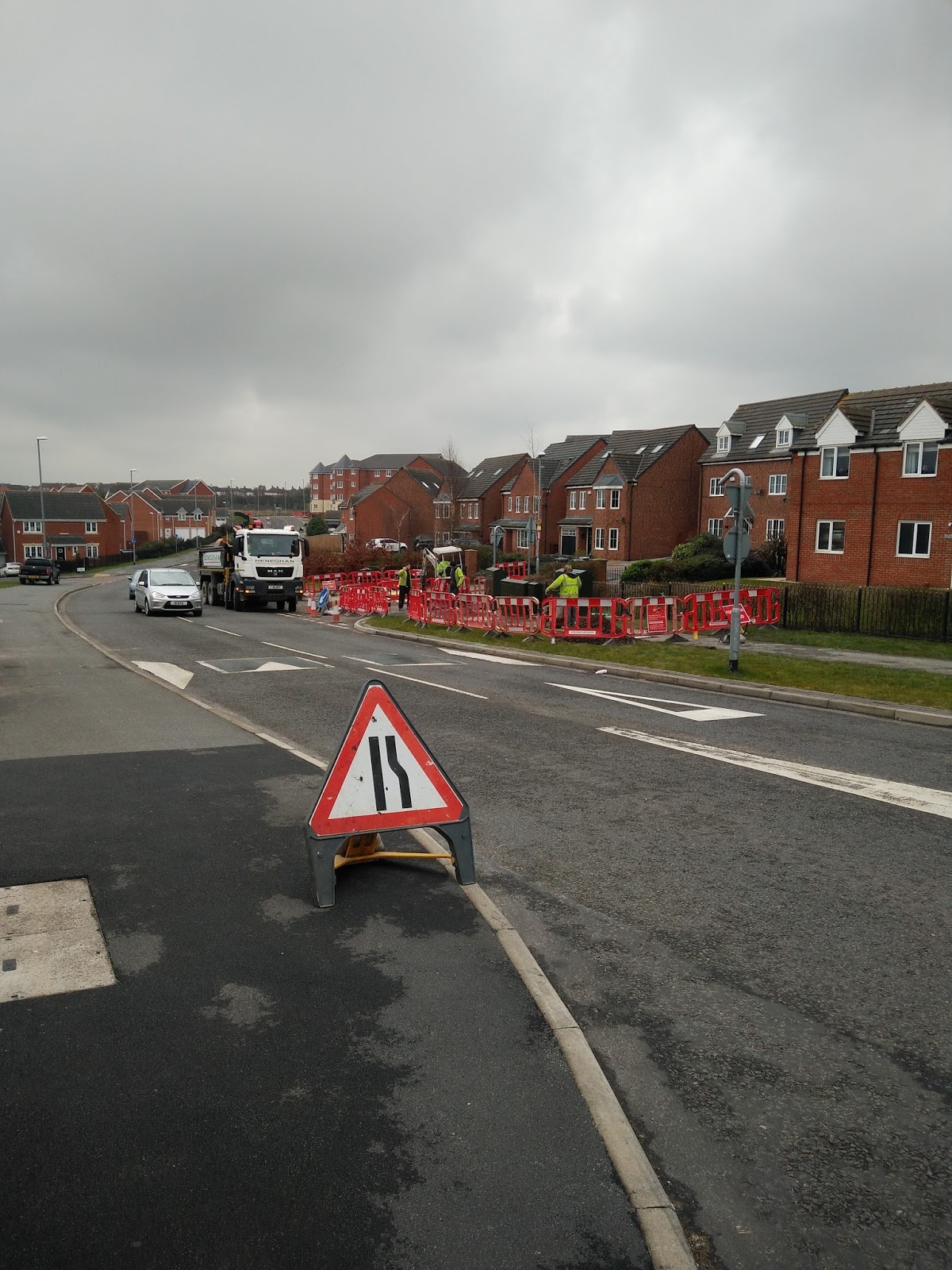 |
| Virgin Media's contractors working around the cabinets I'm typing this through. Thankfully no damage caused! |
 |
| Pavement markings indicating placement of power pillar, MSAN for telephony, and chambers. |


Thursday, 10 March 2016
A monopoly of mediocrity
The announcement of FTTP trials in Bradford alongside 12,500 premises of G.fast in Gillingham had me thinking a little.
One thought was who in Gillingham was influential enough to persuade Openreach to invest some serious money there; it's fair to say that it wasn't in any way related to the benefits it might bring given the entire constituency is 92.2% ultrafast, 98.6% superfast, however I suspect the extensive Virgin Media coverage wouldn't have hurt.

Another, partly inspired by Virgin Media digging up pavements nearby, was to what extent Openreach invested in ultrafast technology and indeed the extent of their investment in urban areas generally during their initial rollout.
I've seen the numbers, however they are put into focus when trawling the Think Broadband data.
Leeds is the 3rd largest city in the UK. It has a population of over 3/4 of a million. It has the largest legal and financial centres in England outside of London. It's home to the Bank of England's office outside of London.
According to Think Broadband it has no native Openreach GEA FTTP. BT's contribution to ultrafast broadband in this entire metropolitan area is, as of right now, zero. Every single FTTP/H premises is Hyperoptic enabled apartments, every ultrafast premises is either them or Virgin Media.

This is something I've felt keenly as I've been looking into home office options to get around a wobbly superfast broadband service. The only business broadband option from BT Group potentially delivering both performance and reliability would cost over £15,000 over the mandatory 3 year contract term, and this wouldn't carry guaranteed performance or availability targets.
A leased line supplier informs that the install quote I received for FTTPoD, the shared fibre service from BT, is 'rather high' and they can install dedicated fibre to my property for 1/3rd that.
AQL can probably offer me a leased line, guaranteed performance and availability, for considerably less than what is basically a business broadband service from BT, which is absurd.
Alternatively I can rent office space. Also cheaper than the BT option.
We should, by now, have an urban core of FTTP/H in the major settlements with FTTC/VDSL on the outskirts, in some market towns and where appropriate rural areas. Instead there is far more FTTP/H per head in rural areas and the amount of it in urban areas, apartment blocks and a few areas built out to for political and other reasons excepted, is vanishingly small.
The UK has one hell of a long way to go and a hell of a lot of work to do moving broadband to the next level in the 'just in time' approach espoused by BT Group. The approach that has allowed Virgin Media to tread water and others to sit back and do nothing to one being upgraded to one that's fit for purpose going forward. Openreach deploying ultrafast in an urban area should not be newsworthy. It's depressing that what should be the status quo, 300Mb being available in a couple of urban areas and gigabit to very limited areas of another, hits the news.
Superfast is the new normal. Ultrafast is the new 'superfast'. Both should be available in our large cities to those who wish to pay.
The market as a whole has, with Ofcom's encouragement and indeed thanks largely to their obsessive over-regulation, become a monopoly of mediocrity.
Friday, 4 March 2016
How much bandwidth does a busy household need?
At the moment our line is running way slower than normal.

Mmm kinda. Here's the Broadband Quality Monitor from yesterday.


So how are things going? Are we managing?
Mmm kinda. Here's the Broadband Quality Monitor from yesterday.
Usage on the line is pretty high during peak periods, the end result being higher latency and jitter. Here's some of the usage over the 'peak' period: this is 6pm - 11pm.

Video isn't quite buffering on YouTube, it just about keeps up but we couldn't sustain 1080p SuperHD Netflix if the line were busy. The latency requires use of some technical methods to manage the line.
Could be worse; could be our line pre-FTTC, though that was also before teenagers were using it!

In summary we can manage but I'm very much looking forward to getting this fixed sooner rather than later as it has the potential to be problematic. We are high-end users, which is why we pay for a business service.
I'm looking into alternative options however, as previously mentioned, there are none besides spending about the price of a car tying ourselves into a 3 year contract... which we may have to do if things can't get sorted.
I'm looking into alternative options however, as previously mentioned, there are none besides spending about the price of a car tying ourselves into a 3 year contract... which we may have to do if things can't get sorted.
Wednesday, 2 March 2016
Virgin Media are trolling me - home office broadband and moving
Walk out of my street and onto the road that serves ours to find this:

Virgin Media are going right past the entrance to our street on their way to properties across the road.
Predictably this work has caused complaints. This is, perhaps, something that Virgin Media are getting quite used to by now. Digging pavements is slow, expensive and, albeit briefly, disruptive.

I have been having some issues with my home office service's reliability and performance that make my desire for a backup that uses a different network all the stronger.
 |
| Less than half usual performance |
A quote for FTTP on Demand not only gave a huge price but I was also told they weren't willing to progress the order due to my road's status.
For many reasons we've been considering a possible house move. Unavailability of alternative broadband options for my home office goes onto the list. It's nowhere near the top but has to go on there.
Over half of the UK has the choice of BT and another fixed line operator.
The vast majority have a choice of BT FTTC and either a >8Mb Openreach ADSL line, cable, wireless or 3G/4G. Sadly we aren't, and have no prospect of being, in that cohort.
FTTC is good enough for most purposes, is far cheaper and faster to deploy so made economic and business sense - I have no complaints about that solution being here. It'd be fine as a primary line for us if we had a backup solution however no cable, no worthwhile ADSL, no wireless and no 3G or 4G puts us almost back to the position we were in during the Fibre for Middleton campaign that saw BT deliver superfast broadband to us.
Maybe we should move to an FTTP-enabled rural village or hamlet; more FTTP serving houses in those than Leeds Central. In common with many other urban areas the fibre to premises in Leeds Central is all delivered to apartment buildings by Hyperoptic. FTTP is by far the most reliable broadband out there so if you can get it, do.
We're between rock and hard place, and while it seems as far as broadband goes the in thing is to complain relentlessly on forums and the comments section of ISP Review, the usual and more constructive solution is to get out from between that rock and hard place.
Update: I just had a local resident ask me when he could expect Virgin Media to cover his street. Had to tell him that if he was lucky it would be 2019. If unlucky never, and that it was extremely unlikely he would have better broadband options than the ones he has now, which are 1Mb if he's lucky or 40-60Mb depending on where in his street he is.
This estate has a household income over 3 times that of the rest of the ward, and far more home businesses and home workers. Much of the estate will have broadband of at best 1/8th the performance of the rest of the ward and more likely 1/14th to 1/25th by 2019.
There's a digital divide.
Subscribe to:
Posts (Atom)